Cart
0

Our grandmothers didn't call it organic. They didn't need to.
The rice that came in every autumn was the same variety it had always been, grown the same way it always had been, stored in the same wide-mouthed clay jar it always sat in. The honey arrived once a year from someone who knew someone in the Sundarbans. The date palm jaggery showed up only in winter, because that was the only time it could. Nothing was available year-round. Everything was exactly right.
This wasn't a curated lifestyle. It was just food — the way Bengal actually grew and ate it for centuries before plastic packets, shelf-life calculations, and chemical preservatives entered the picture. And the quietly alarming fact is that most of it still exists. It just got harder to find.
Why Bengali Food Was Always Ahead of the Curve?
Bengal's food traditions were built around a logic that modern nutritionists spend careers trying to rediscover: eat local, eat seasonal, keep it unprocessed. The soil of Bengal's 23 districts grows rice varieties that have been cultivated here for over 4,000 years. The forests produce honey that no factory can replicate. The orchards give mangoes that become preserves and condiments, unlike anything mass-produced.
None of it was called a superfood. None of it needed to be. It was simply what people ate because it was what the land gave them, and the land here gave extraordinarily well.
What's changed is that most of us no longer live near those farms, those forests, or those orchards. We live in cities, or far outside Bengal entirely, and the link between land and table that used to be automatic has been broken. A good natural food store is, in some quiet way, the attempt to repair that link — to source what the land still produces and put it back where it belongs.
The Rice Your Dida Knew Had a Name
Not all rice is the same. Anyone who grew up eating Gobindobhog for payesh, or who knows the difference between how atap rice and sheddo rice cook, understands this at a cellular level. Bengal rice isn't a single thing. It's a living archive of regional agriculture, each variety shaped by the soil, water, and climate of a specific place.
Tulaipanji Rice is one of the more remarkable entries in that archive. Indigenous to the Raiganj subdivision of North Dinajpur, it's a non-basmati aromatic rice with a medium-long slender grain that stays bright and separate when cooked — not sticky, not heavy, genuinely fragrant. The Government of West Bengal sent Tulaipanji Rice to the food festival at the 2012 London Olympics. It holds a Geographical Indication tag. And it's grown without chemicals, the way it always was.
At The Bengal Store, both the parboiled (atap) and boiled (sheddo) versions of Tulaipanji Rice are available, sourced clean, pesticide-free, and packed the same way you'd want bengal rice to arrive: with nothing added and nothing taken away.
If Tulaipanji Rice is new to you, it's worth knowing alongside Gobindobhog, Radhatilak, and the other heritage varieties that made bengal rice something people across the country knew by name long before "heritage grains" became a food trend.
The Honey That Comes From the World's Largest Mangrove Forest
There is a particular category of honey that simply cannot be factory-farmed. The Sundarbans produce it. The Mouals — the traditional honey gatherers of the forest — collect it. And it arrives at you either raw and real, or it doesn't arrive in the meaningful sense at all.
Raw unprocessed honey Bengal means exactly that: no heat treatment, no filtration, no added sugar, nothing that touches the honey between the honeycomb and the jar. What makes Sundarbans honey different from the golden syrup sold in most supermarkets is precisely the absence of any of those interventions. The floral sources are wild mangrove blooms. The mineral content reflects the Sundarbans' unique soil and water. The antibacterial properties that traditional medicine has always attributed to honey are actually present because they haven't been boiled away.
Since 2024, Sundarban Honey carries a registered Geographical Indication for West Bengal, which means the product you're buying is traceable to a specific landscape, not a generic category called "honey."
When you buy Sundarban honey from The Bengal Store, it comes directly from those Moualis — unchanged, unprocessed, carrying the forest with it. That's the difference between raw, unprocessed honey Bengal produces and what most jars on a supermarket shelf actually contain.
Nolen Gur: The Natural Sweetener That Arrives in Winter
Winter in Bengal means many things — Durga Puja is over, the air has a sharp edge by evening, and the date palms start weeping sap. That sap is tapped, collected, and reduced into a jaggery so specific to its season that it genuinely cannot exist at any other time of year.
Nolen gur — fresh liquid date palm jaggery — has a caramel depth that ordinary sugar cannot touch, and a slight smokiness that comes from the reduction process. It goes into payesh, patishapta, dudh puli, chitoi pitha, and sandesh. It goes over hot luchi at breakfast. It is, for anyone who grew up Bengali, the flavour most closely associated with the turn of the season.
When you buy nolen gur online, what matters is that you're getting Jhola Nolen Gur — the liquid form — pure and unadulterated, not a processed solid approximation. The Bengal Store's Jhola Nolen Gur is available in a 450g bottle, sourced from traditional artisans in West Bengal, with no additives and no preservatives. It's the same jar your dida's winter kitchen used to have on the top shelf, but you can now buy nolen gur online and have it delivered, even if you're nowhere near a Bengali winter.
Aam Kasundi: The Condiment That Summer Built
If you had to pick one Bengali condiment to explain to someone who's never eaten Bengali food, it would probably be Aam Kasundi. It's a fermented mustard sauce made with raw green mangoes, sharp enough to make your eyes water, tangy enough to cut through oil, complex enough to hold its own against the strongest fish fry.
Aam Kasundi is a summer project. The mangoes are sun-dried, the mustard seeds are ground, the spices go in, and then the whole thing ripens for weeks. It arrives at your table carrying months of patience inside it. As a digestive aid, it has antioxidant properties that traditional households understood long before the word antioxidant was coined.
The Bengal Store's Aam Kasundi is made by women artisans who've inherited this preparation exactly — no preservatives, no shortcuts, the same sun-ripened process that the recipe has always required. It works as a dip for telebhaja, a base for gravies, a spread for sandwiches, or stirred straight into hot rice with ghee.
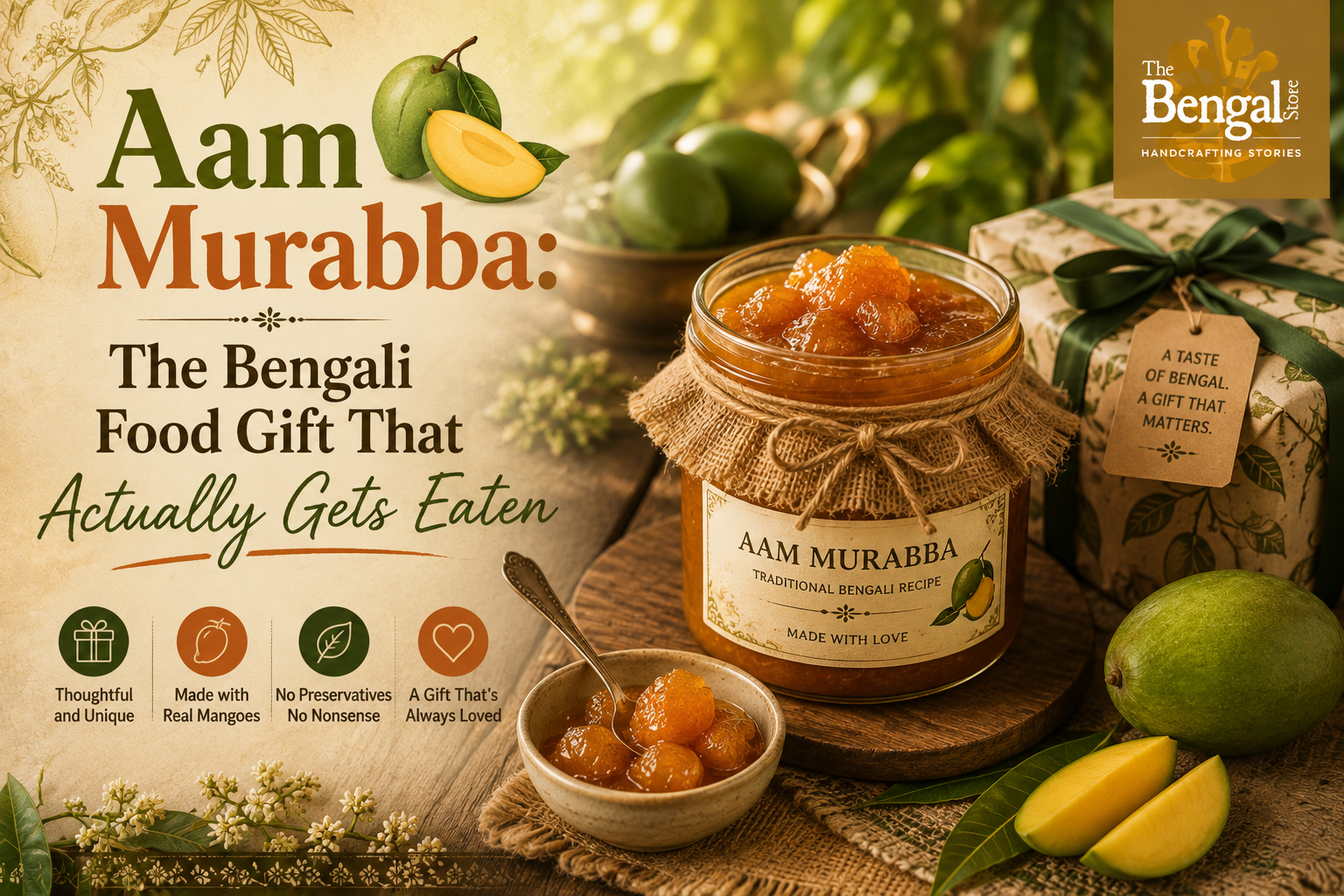
Buy Aam Murabba: The Sweet That Understood Mango Best
Before the mango sweetens on the tree, when it's still hard and fiercely sour, Bengali kitchens knew what to do with it: cook it slowly with sugar or jaggery until it becomes a preserve that holds that tartness inside its sweetness.
Aam Murabba is that preserve. It has the concentrated flavour of raw mango carried through heat and time into something that keeps for months and tastes like a much more complicated version of the fruit. A spoonful with rice is a meal. A spoonful on its own is just right after lunch.
Buy Aam Murabba from The Bengal Store alongside the Aam Kasundi and the Aam Gur, or take the easier route and order the Mango Delicacies combo — all three together in one order, which is exactly how a Bengali grandmother would have stocked her mango season.
What a Natural Food Store Actually Does
The Bengal Store isn't applying a trend to Bengali food. This is a natural food store built on the premise that Bengal's food traditions were right all along, and that what they need isn't reinvention but access.
The farmers who grow Tulaipanji Rice without pesticides. The Mouals, who collect raw, unprocessed honey from mangrove combs. The women who spend weeks making Aam Kasundi the slow way. These people and their methods exist. What they need is a market, and what you need is a way to reach them without living next door.
That's the entire point of a natural food store like this one: to be the connection that geography has broken. When you buy Sundarban honey, buy nolen gur online, buy Aam Murabba, or find the right variety of Bengal rice — you're not buying nostalgia. You're buying the actual food. The food your grandparents ate was good, before anyone had to explain why.
Browse the full food collection at The Bengal Store and find what your pantry has been missing.
Frequently Asked Questions About Traditional Bengali Natural Foods
What makes Tulaipanji Rice different from regular rice?
Tulaipanji Rice is an indigenous aromatic rice variety from North Dinajpur in West Bengal, with a GI tag certifying its origin. It's non-sticky when cooked, medium-long grained, and naturally fragrant. The Bengal Store sources it as chemical-free Bengal rice, grown without pesticides using traditional methods.
Why should I buy Sundarban honey from a specialist store?
When you buy Sundarban honey from The Bengal Store, it's sourced directly from Mouals, the traditional honey gatherers of the Sundarbans. This traceability ensures you're getting genuine forest honey, not a blended product. The honey carries a Geographical Indication, making provenance verifiable.
When is the right time to buy nolen gur online?
Nolen gur is a winter product, harvested from date palms between roughly November and February. When you buy nolen gur online from The Bengal Store, the Jhola (liquid) variety comes in a 450g bottle and is available while supplies last. Ordering early in the winter season is advised.
What is Aam Murabba and how do you eat it?
Aam Murabba is a traditional Bengali mango preserve made from raw green mangoes cooked with sugar or jaggery until they become a sweet-tart conserve. It's eaten with rice as a course, served as a digestive at the end of a meal, or used as a sweet-sour spread. When you buy Aam Murabba from The Bengal Store, it comes preservative-free and made to traditional proportions.
What makes The Bengal Store a reliable natural food store?
The Bengal Store sources its food range from across Bengal's 23 districts, working directly with small-scale farmers, women producers, and traditional artisans. As a natural food store, every product is chemical-free and preservative-free, with traceability back to the producer — rice, honey, jaggery, condiments, and preserves included.