Cart
0
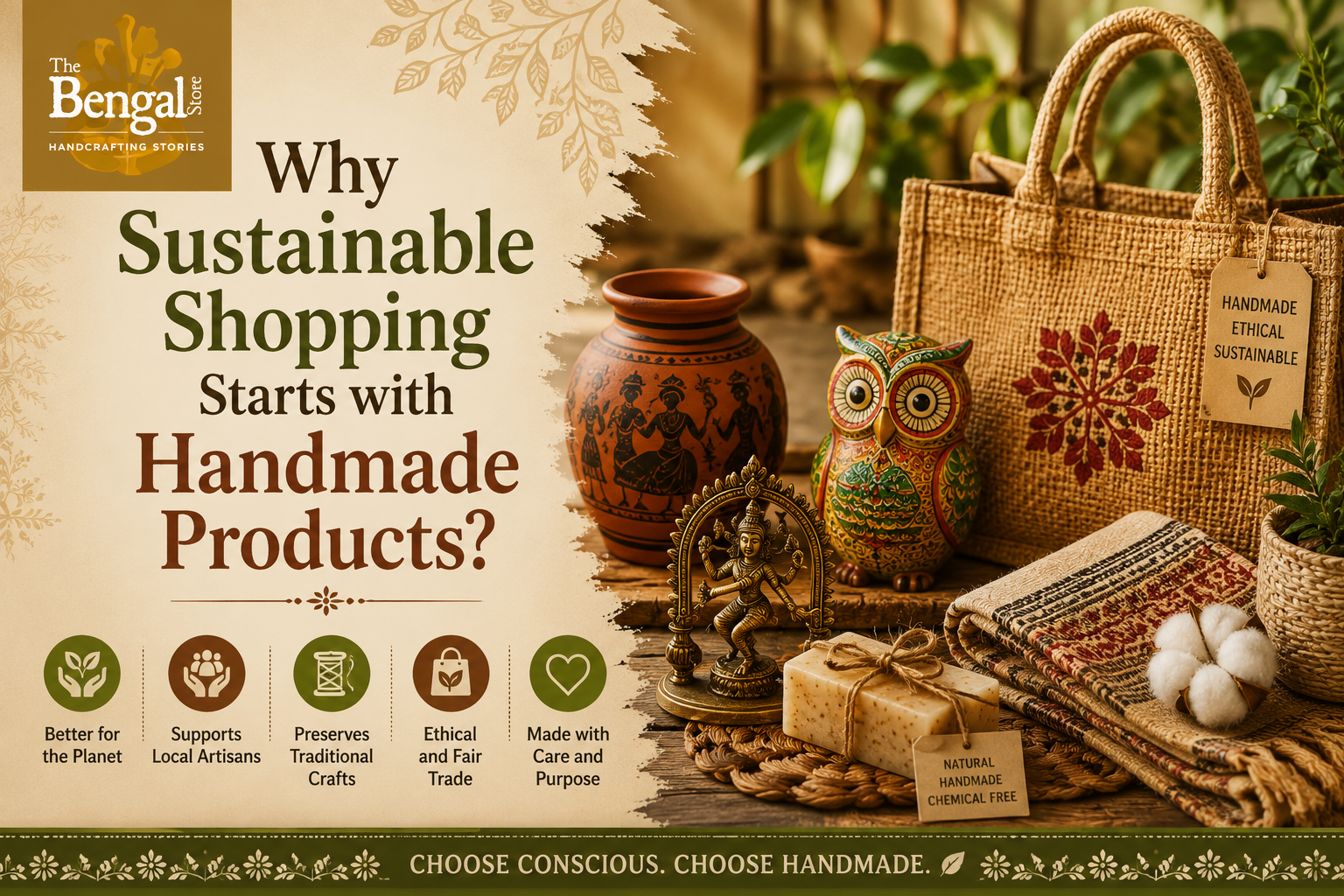
Every year, shoppers are told to “go sustainable” through longer checklists — recycled packaging, carbon offsets, refill schemes. But the simplest sustainable habit is also the oldest one: buy handcrafted items online instead of mass-produced ones. The Bengal Store is a one-stop craft store built around exactly this idea — sourcing Bengal handicrafts directly from artisan communities across West Bengal's 23 districts, so every purchase supports a real maker instead of an anonymous supply chain.
What Does Sustainable Shopping Actually Mean?
Sustainable shopping means choosing products based on their full lifecycle — the raw materials used, how they're made, how long they last, and what happens when they're discarded — rather than on price or convenience alone. It favours durability, traceable sourcing, and fair livelihoods for makers over speed and volume.
In practice, this is less about a single eco-label and more about a pattern of choices: fewer purchases, made more carefully, from sources you can actually verify. A handcrafted terracotta lamp or a hand-cast Dokra figurine passes that test in a way a shrink-wrapped decor item rarely can, because you can trace it to a district, a technique, and often a named artisan cluster.
Why Handmade Products Are Inherently More Sustainable?
Handmade products are more sustainable because they're produced in small batches using manual skill, natural materials, and minimal mechanised energy, which limits emissions and waste at the source. Mass production, by contrast, depends on synthetic materials, high-volume assembly lines, and long global shipping routes that compound environmental cost at every stage.
The scale of that gap is well documented. The UN Environment Programme reports that the textile industry accounts for 2 to 8 percent of global greenhouse gas emissions and uses water equivalent to 86 million Olympic-sized swimming pools every year. Separately, the Geneva Environment Network notes that around 85 percent of textiles produced end up dumped or incinerated each year — a direct consequence of fast, synthetic, mass-market production.
Bengal handicrafts sit on the opposite end of that spectrum. Terracotta is fired clay, jute and Sabai grass are plant fibres, brass and bell metal are recyclable, and Kantha embroidery repurposes old cotton saris into new textiles. None of it depends on virgin plastic or synthetic fibre, and production volumes are, by nature, small and local rather than industrial.
Buying Bengal Handicrafts Online in Kolkata — Why Sourcing Matters
When you buy crafts online in Kolkata through a curated bengal craft store, each item can usually be traced to a specific artisan cluster — Dokra casting from Bankura, terracotta from Bishnupur, Kantha embroidery from Nadia and Murshidabad — instead of a vague, multi-country supply chain. That traceability is itself a sustainability marker, because it keeps production local, small-scale, and low-emission.
The Bengal Store operates as a one-stop online and offline store celebrating crafts, textiles, and agro-products from Bengal's 23 districts, and works to connect Bengal to buyers everywhere while supporting hundreds of artisans across the state (see About Us). Its physical store sits in Jodhpur Park, South Kolkata (see Our Store), and the same curated collections ship online across India and internationally — so a craft store in Kolkata no longer means a single physical shelf; it means direct access to dozens of Bengal's artisan traditions from anywhere. For a closer look at what a Kolkata-based craft store can offer, see Best Craft Store in Kolkata for Unique Home Decor Finds.
Sustainable Home Furnishing: Handmade vs Mass-Produced
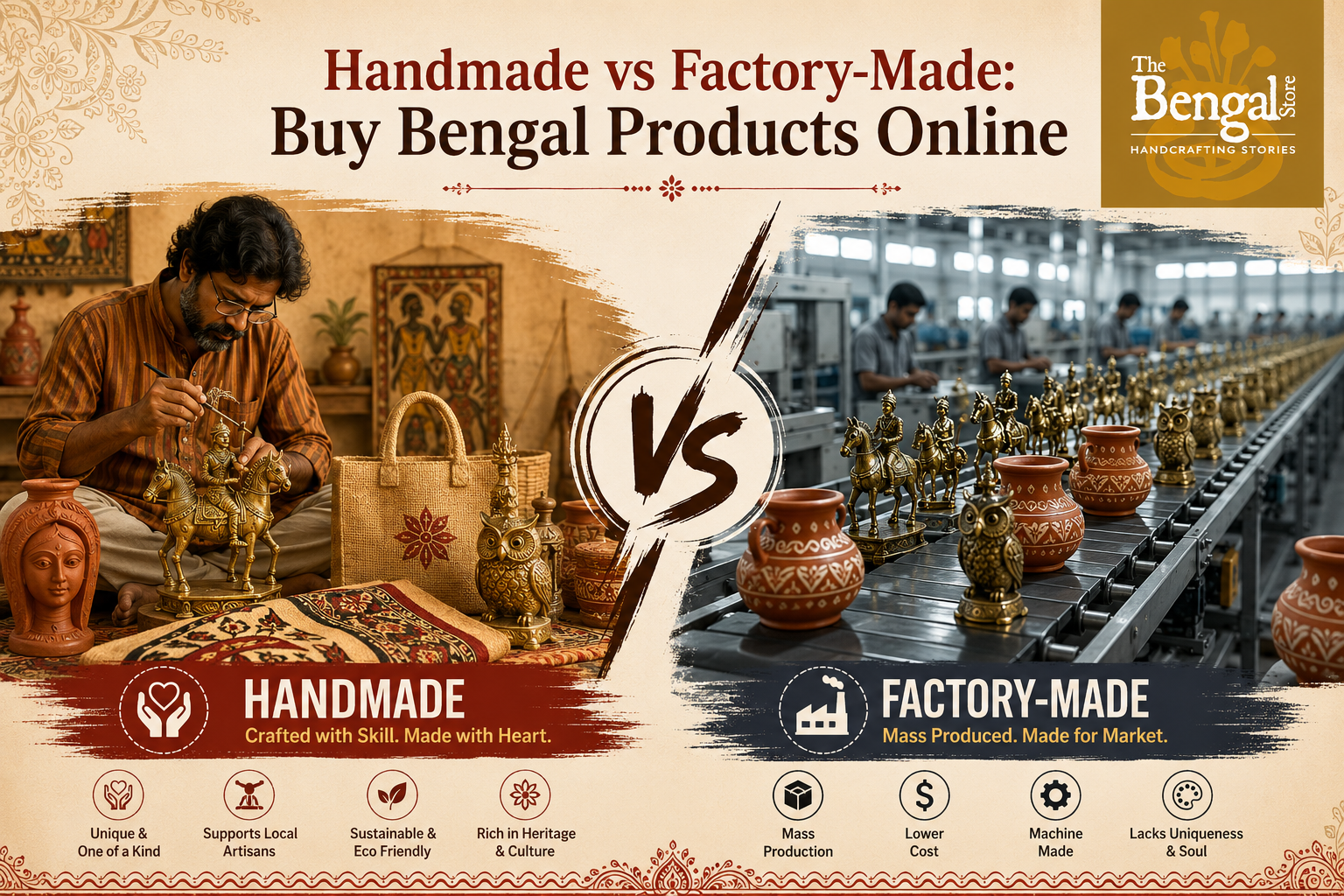
Sustainable home furnishing means choosing pieces built to last from natural, traceable materials, and handcrafted home furnishing products consistently outperform mass-produced décor on durability, material origin, and end-of-life impact. A side-by-side comparison makes the gap easy to see.
|
Factor |
Handcrafted Bengal Home Furnishing |
Mass-Produced Décor |
|
Material |
Natural: jute, cotton, terracotta, brass, water hyacinth |
Often synthetic: plastic, MDF, polyester blends |
|
Production |
Small-batch, manual, artisan-led |
High-volume, machine-led factory assembly |
|
Typical lifespan |
Years to decades; often passed down |
Months to a couple of years |
|
End-of-life |
Biodegradable or recyclable |
Frequently landfill-bound |
|
Supply chain |
Traceable to a named artisan or district |
Often opaque, multi-country |
This is why handcrafted home furnishing is worth seeking out specifically for Bengal — the category spans Kantha and embroidery cushion covers and quilts, water hyacinth trays and coasters woven from Bengal's wetland reeds, and jute craft baskets and mats. Each swaps a synthetic, factory-made equivalent for a natural, hand-finished one without asking you to change how a room actually functions.
How to Buy Handcrafted Items Online Without the Guesswork?
Buying handcrafted items online sustainably comes down to five checks: verified artisan sourcing, natural materials, transparent pricing, real production stories, and a seller who ships responsibly. Skipping these checks is how the word “handmade” ends up loosely attached to products that aren't.
-
Named origin: the listing should say which district or artisan cluster made it, not just “handmade in India.”
-
Material clarity: terracotta, brass, jute, cotton, or water hyacinth should be stated outright, not hidden behind vague terms like “natural finish.”
-
Realistic production time: genuine handcraft often has longer dispatch windows than mass-market listings, because it's made to order or in small batches.
-
Price that reflects labour: a price far below what hand-skill and material would reasonably cost is a sign the item may not be handmade at all.
-
A seller with a physical footprint: stores with an actual workshop, store, or artisan network — not just a dropshipping catalogue — are easier to verify and hold accountable.
The Artisans Behind Bengal Handicrafts
Bengal handicrafts survive because specific artisan communities keep them alive — Dokra casters in Bankura, terracotta potters in Bishnupur, Kantha embroiderers across Nadia and Murshidabad, and jute and water hyacinth weavers in Bengal's wetland districts. The Bengal Store works directly with these communities, connecting their work to buyers across India and abroad.
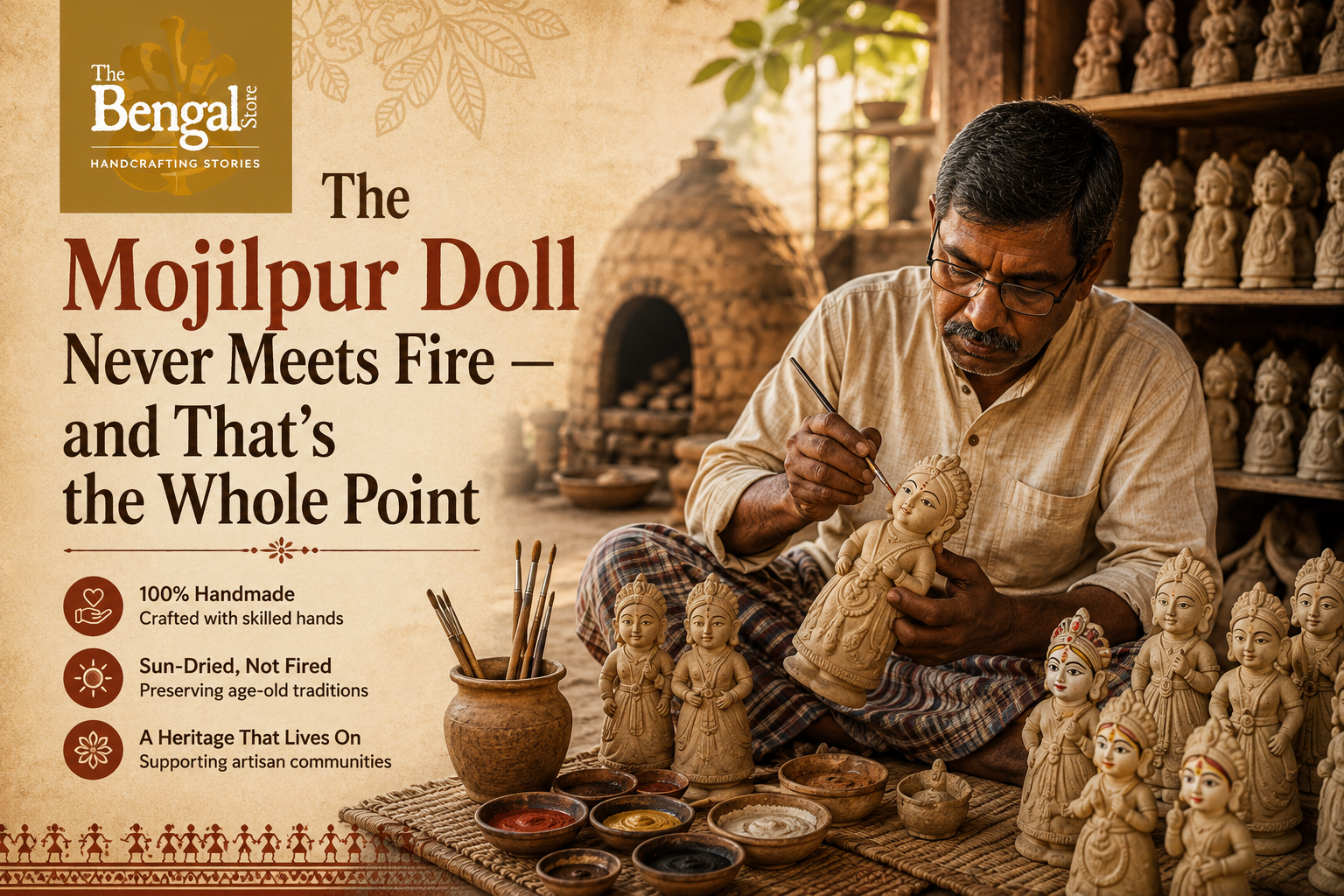
This is also where sustainability and cultural preservation overlap. UNESCO's Intangible Cultural Heritage programme notes that traditional craftsmanship offers communities a livelihood built on inherited knowledge and skill, and that safeguarding it depends on real, ongoing demand — not preservation for its own sake. Every purchase of a Dokra figurine or a Kantha textile is, in that sense, a small vote for keeping a specific, place-based skill economically viable. For a closer look at one such community, read The Kumors of Mojilpur Are Still Here — And Their Clay Gods Are Breathtaking.
Sustainable shopping doesn't require a lifestyle overhaul. It starts with a simple substitution: the next time you'd buy a mass-produced decor piece, choose a handcrafted one instead. Explore The Bengal Store's crafts collection to find Bengal handicrafts — from Dokra and terracotta to jute and water hyacinth — made by named artisan communities across West Bengal's 23 districts, built to last, and shipped across India and beyond.
6. FAQ Section
Is handmade always more sustainable than machine-made?
Generally yes, because handmade production uses less mechanised energy, favours natural materials, and happens in smaller batches. It isn't automatic — a handmade item shipped wastefully or made from synthetic material can lose some of that advantage — but on balance, handcraft production carries a lighter footprint than industrial manufacturing.
What makes Bengal handicrafts sustainable?
Bengal handicrafts rely on natural, local materials — terracotta clay, jute, brass, cotton, and water hyacinth — worked by hand in small batches close to where the material is sourced. This keeps transport, energy use, and synthetic input close to zero compared with mass manufacturing.
Where can I buy handcrafted items online in India?
The Bengal Store sells Bengal handicrafts online across India and internationally, alongside a physical store in Jodhpur Park, Kolkata. Its crafts collection covers Dokra, terracotta, jute, water hyacinth, and brass, each sourced from a named artisan cluster.
Are Bengal handicraft home furnishings expensive?
Prices vary by material and technique, but many handcrafted home furnishing pieces are comparable to mid-range mass-produced décor, and often cost less over time because they last for years rather than months.
How do I know a craft store in Kolkata sells authentic handmade products?
Authentic sellers name the artisan cluster or district behind each product, describe the material and technique specifically, and are transparent about production time and pricing. A vague “handmade” label with no origin details is a sign to ask more questions before buying.