Cart
0
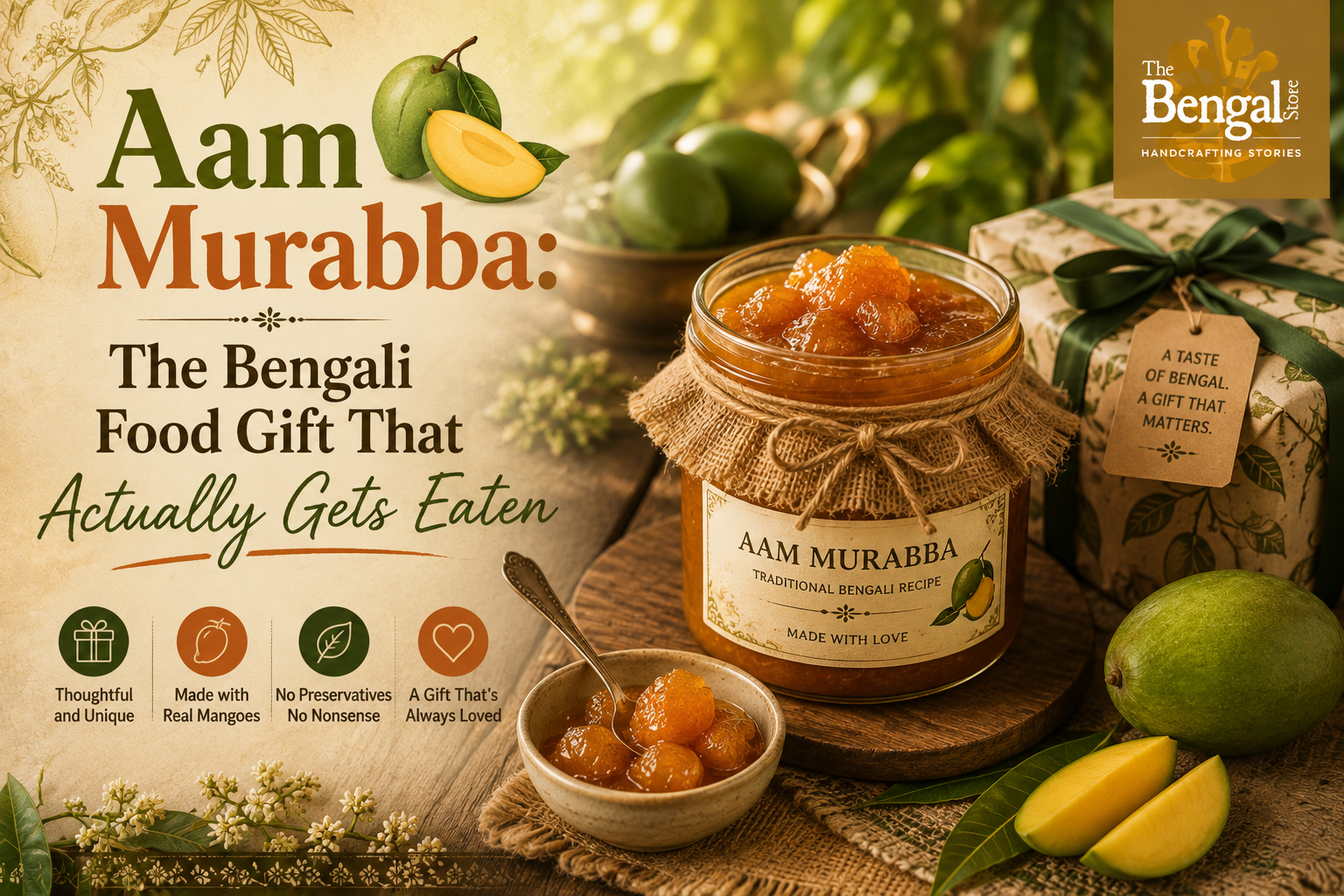
Most food gifts fail in the same way — they look impressive, sit unopened for six months, and quietly get passed along to someone else. When you buy Aam Murabba online, you're giving the opposite: a jar that gets opened within the week and finished within the month. The Bengal Store is a one-stop online and offline store celebrating crafts, textiles, and chemical-free food from Bengal's 23 districts, and its Aam Murabba — Rs. 250 for a 200g jar — is one of the few gifts on the site that a recipient will genuinely run out of.
What Is Aam Murabba?
Aam Murabba is a traditional Indian preserve made by cooking unripe green mangoes in concentrated sugar syrup with aromatic spices until the fruit turns translucent and shelf-stable. Unlike Western jam, which purees fruit into a spread, murabba keeps the mango pieces whole, so each spoonful delivers texture alongside a sweet, tangy, faintly piquant flavour.
The name comes from the Arabic murabbā, meaning “preserved,” and the technique travelled into Indian kitchens through Persian and Mughal culinary exchange. Scroll.in documents that when Daulat Khan Lodhi invited Babur to march on Delhi, the invitation arrived with half-ripened mangoes preserved in honey — and that Babur, in his memoirs, noted unripe mangoes made excellent condiments and preserved well in syrup. A jar of Aam Murabba is, in that sense, a gift with a genuinely long paper trail behind it.
Why Aam Murabba Works Better Than Most Food Gifts
Aam Murabba solves the four problems that sink most edible gifts: it needs no refrigeration, it doesn't spoil in transit, it fits vegetarian, eggless, and most religious dietary patterns, and it's a condiment rather than a dessert — so it gets used across many meals rather than consumed once and forgotten.
Consider what usually goes wrong. Chocolate melts in a Kolkata summer. Bakery boxes have a three-day window. Dry fruit hampers are generous but interchangeable, and everyone receives four of them each Diwali. A wine or spirits gift rules out a large share of Indian recipients outright.
A jar of murabba avoids all of it. The sugar does the preserving work — the high concentration lowers water activity enough to prevent microbial growth, which is why the format survived centuries before refrigeration existed. Practically, that means you can courier it to Bangalore or carry it to a relative in New Jersey without a cold chain. The Bengal Store ships it free across India, and the shipping and logistics page covers the details for longer routes.
What Makes The Bengal Store's Aam Murabba Different
The Bengal Store's Aam Murabba is made with no chemicals or preservatives by an all-women producer group in Bengal, using unripe mangoes and handpicked aromatic spices. That sourcing detail is the difference between a mass-market jar and a gift that carries a story the recipient can repeat when someone asks where it came from.
This matters more than it sounds. The reason a food gift lands is rarely the food alone — it's that the giver clearly chose it rather than grabbed it. “It's mango murabba, made by a women's collective in Bengal, no preservatives” is a sentence a recipient will repeat at their own dinner table. “It's a chocolate box” is not. The same logic runs through The Bengal Store's food range, which is built on chemical-free products sourced from across the state — something the earlier post From Bengal's Farms to Your Table covers in more depth.
Aam Murabba vs the Combo: Which Should You Gift?
Buy the single 200g Aam Murabba jar at Rs. 250 for casual gifting — a thank-you, a housewarming, a first-time gift where you're unsure of taste. Choose the Rs. 600 Pickles Combo when you want the gift to feel substantial, because three jars covering sweet, pungent, and sour read as a considered hamper rather than a single token.
|
Gift Option |
Price |
Best For |
Why It Works |
|
Aam Murabba, 200g |
Rs. 250 |
Housewarmings, thank-yous, first-time gifting |
Single jar, low commitment, easy to post |
|
Pickles Combo: Aam Kasundi + Aamloki + Aam Murabba |
Rs. 600 |
Festive hampers, Pujo gifting, NRI family |
Three 200g jars, sweet-sour-pungent range |
|
Multiple jars (2-5) |
Rs. 60-150 off, auto-applied |
Office gifting, multiple recipients |
Tiered discount at checkout, no coupon needed |
The Pickles Combo pairs Aam Murabba with Aam Kasundi — the fermented mustard sauce made with sun-dried mangoes — and Aamloki, the tart gooseberry pickle. Together they cover the full sweet-to-sour range a Bengali meal moves through, which is why the combo works better for someone who already knows and misses this food than a single sweet jar would. If you want the emotional case for kasundi specifically, One Spoonful of Kasundi and Suddenly You're Back at Dida's Table makes it well.
Who each option suits
-
The colleague or neighbour: a single 200g jar. Warm, specific, not so expensive it creates an obligation to reciprocate.
-
The relative abroad: the combo. Nostalgia is the point, and three jars extend the reminder over months rather than weeks.
-
The serious home cook: the combo, because they'll actually cook with the kasundi rather than just eat it as a side.
-
Multiple recipients at once: stack jars. Buying 2 takes Rs. 60 off, 3 takes Rs. 90 off, up to Rs. 150 off on 5 — applied automatically at checkout with no coupon code.
How to Serve and Present Aam Murabba
Aam Murabba is served as a condiment beside a meal — traditionally with roti, paratha, khichuri, or plain rice and dal — and works equally well spooned over thick curd or paired with sharp cheese. To present it as a gift, pair the jar with something handmade rather than wrapping paper, which turns a Rs. 250 item into a considered package.
A practical suggestion: set the jar on a water hyacinth coaster or small woven tray from the same store. It costs little, arrives in the same order, and gives the recipient something that stays behind after the murabba is finished. For a food lover who also cooks seriously, a jar alongside a Bengali cookbook from the books collection makes an unusually well-matched pair.
The best food gifts aren't the most expensive ones — they're the ones that get opened. Buy Aam Murabba online at Rs. 250 for 200g, or choose the Rs. 600 Pickles Combo with Aam Kasundi and Aamloki for a hamper that covers Bengal's full sweet-to-sour range. Both ship free across India, and buying two or more jars applies a discount automatically at checkout.
6. FAQ Section
What is Aam Murabba?
Aam Murabba is a sweet-and-tangy preserve made by cooking unripe green mangoes in sugar syrup with aromatic spices until the fruit turns translucent and shelf-stable. Unlike Western jam, murabba keeps the fruit pieces whole rather than pureeing them, so you get texture along with the sweetness.
Is Aam Murabba a good gift?
Yes. Aam Murabba works well as a gift because it's shelf-stable without refrigeration, suits most diets, carries genuine regional character, and gets eaten rather than stored away. A 200g jar from The Bengal Store costs Rs. 250 and ships free across India.
How long does Aam Murabba last?
Sugar-preserved murabba is traditionally shelf-stable for several months at room temperature, because the high sugar concentration lowers water activity and prevents microbial growth. Check the label on your specific jar, and use a dry spoon each time so you don't introduce moisture.
How do you eat Aam Murabba?
Aam Murabba is eaten as a condiment alongside a meal — most commonly with roti, paratha, khichuri, or plain rice and dal. It also works spooned over curd, paired with cheese, or served at the end of a meal the way Bengali households traditionally close with something sweet.
Where can I buy Aam Murabba online in India?
The Bengal Store sells Aam Murabba online with free shipping across India, in a 200g jar at Rs. 250 or as part of a Rs. 600 pickles combo with Aam Kasundi and Aamloki. It's also available at the Jodhpur Park store in South Kolkata.
Does Aam Murabba contain preservatives?
The Bengal Store's Aam Murabba is made without chemicals or added preservatives, relying on sugar as the preserving agent the way the technique has worked for centuries. It's prepared by an all-women producer group in Bengal rather than in an industrial plant.