Cart
0
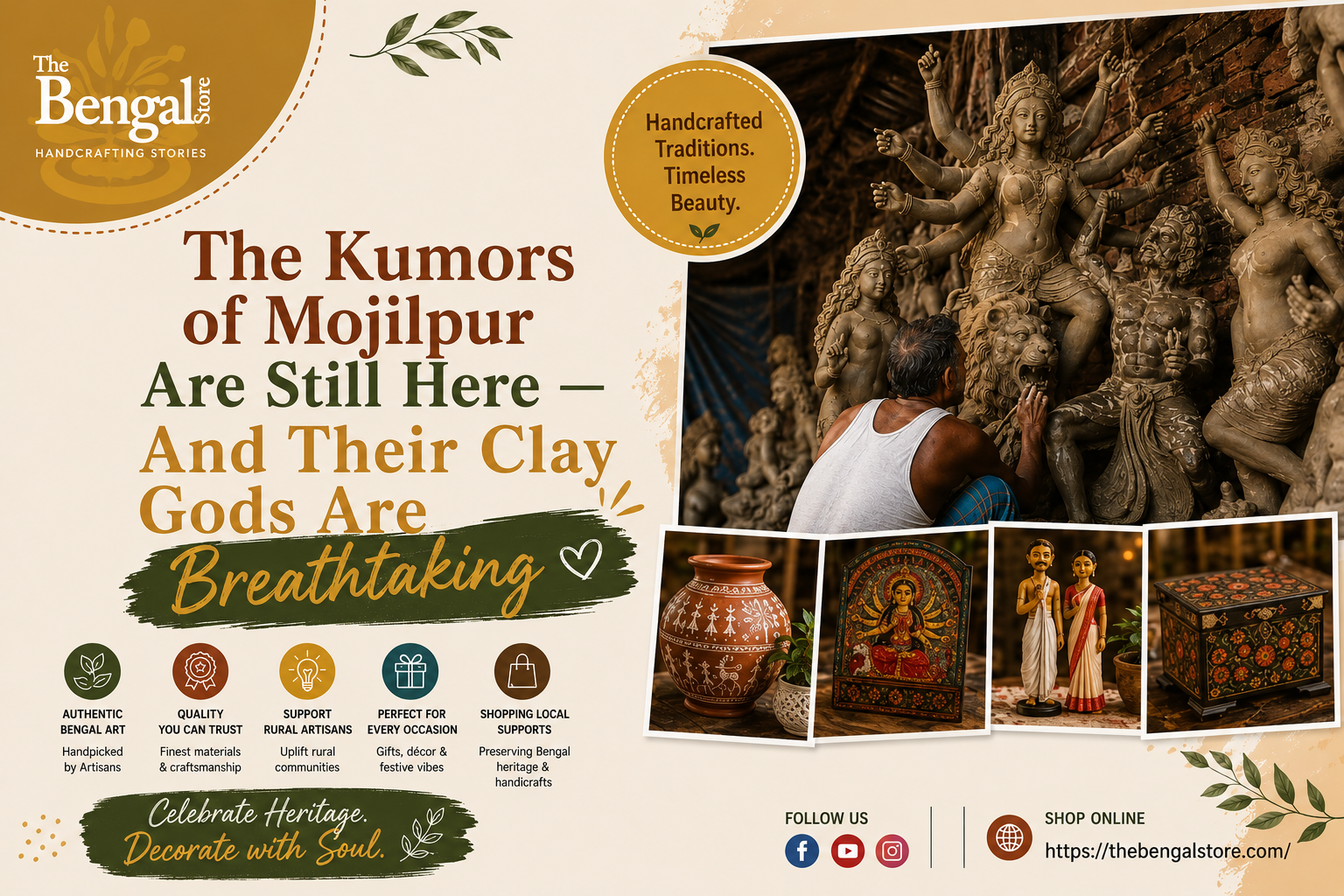
A few hours south of Kolkata, past the highway noise and the city's constant motion, the village of Joynagar-Mojilpur sits quietly in South 24 Parganas. Nothing announces itself. No signboard, no heritage plaque. But walk into the right lane, and you'll find a man working at a small table, pressing river clay into a mould with practised fingers, and emerging from those hands will be a goddess, 10 inches tall, vibrant with colour, wearing the calmest smile you've ever seen on a deity associated with destruction.
That man is Sambhu Das. And if you don't know his name yet, this is the moment to learn it, because he may be the last person in Bengal who still makes these idols the way they were always made.
A Legacy Born in Jessore, Carried Across Borders
The Das family's roots aren't in Mojilpur at all. Sambhu Das's grandfather, the legendary Manmatha Das, migrated to West Bengal from Jessore in what is now Bangladesh, bringing with him an art form that the subcontinent's partition could have swallowed whole.
Instead, Manmatha Das built something. He refined the clay doll tradition of Joynagar-Mojilpur into something the country noticed. In 1986, the President of India honoured him with the prestigious President's Award for his masterful clay depictions of Jagannath, Balaram, and Subhadra.
Think about what that award represents. Not a regional art fair. Not a craft mela stall. The highest civilian recognition in the country, for a man pressing clay from a Bengal riverbank into the shapes of gods. Sambhu Das inherited that legacy, and he's still carrying it forward alone.
What Makes a Mojilpur Idol Unlike Any Other
The moment you hold a Mojilpur Durga Idol or a Mojilpur Shiv-Durga Idol in your hands, you understand why people travel to find them. These are not the sharp, dramatic idols of Kumartuli or the hyper-realistic clay portraits of Krishnanagar. Mojilpur has its own visual language, and once you see it, you can't mistake it for anything else.
Start with the process itself. Most fired-clay dolls are solid. Mojilpur's are hollow, formed by pressing clay into two-part moulds that get joined together. The figurines of gods and goddesses skip the kiln entirely. They dry in the sun instead, which gives the clay a different quality, softer at the surface, warmer to the touch.
Then comes the colour. Broad, confident brushstrokes in deep reds, blues, yellows, and greens paint these figures in a manner that shares something with Kalighat pata paintings. The lines are fluid, almost cartoon-like, and completely intentional. This is not a shortcut. It's the unique style of the creator.
Finally, each piece is coated in garjan oil, balsam extracted from local trees, which sinks into the clay and gives the finished doll its unmistakable lustrous finish. Pick up a Mojilpur God Dolls piece and the surface catches the light differently depending on the angle. That's the garjan oil. No synthetic varnish does the same thing.
The Divine Forms Sambhu Das Still Crafts
The range of figures that have come out of this tradition reads like a pocket guide to the Bengali divine imagination. Mojilpur Durga Idol pieces show the goddess in her quieter aspect, serene rather than fierce. The Mojilpur Shiv-Durga Idol places Shiva and Parvati together in the domestic warmth that Bengalis love rather than the cosmic grandeur that dominates other schools.
The Mojilpur Goddess Kali is perhaps the tradition's most striking statement. Kali, the figure most artists depict mid-rage with her tongue out and a severed head in hand, comes out of Mojilpur looking almost cheerful. Rounded, slightly plump, smiling. This isn't irreverence. It's a particular Bengali affection for their terrifying goddess. The same Kali who accepts sweets on Diwali night is the one Sambhu Das moulds into clay, and the effect is startlingly tender.
Beyond the divine, the tradition also captures the everyday. The Mojilpur Babu Putul, the gentleman doll, portrays the colonial-era Bengali babu in his starched dhoti and jacket, a figure of both affection and gentle satire. From policemen to postmen, Mojilpur's artists have always immortalised whoever walked past their doors. The divine often takes centre stage, but everyday life has always found a place beside it.
One Man, One Tradition, One Real Urgency
Here is the difficult part. Sambhu Das is currently the only artist in Bengal who still makes Mojilpur God Dolls using this method. Not one of the few. The only one.
That's not an exaggeration for dramatic effect. The narrow economics of traditional craft, the absence of institutional support, the sheer time and skill the process demands without commensurate returns, have pushed most families in the tradition out. Sambhu Das is what remains. The art is, in every practical sense, one life away from disappearing.
When you buy traditional products like these, the transaction means something different from clicking Add to Cart on mass-produced decor. You're not just buying an object. You're giving an artisan a reason to keep working the clay tomorrow morning.
Where to Find These Idols Without Searching All of South Bengal
The Bengal Store, located in Jodhpur Park, Kolkata, has worked directly with Sambhu Das to bring his work online, which is the only reliable way to buy crafts online in Kolkata or from anywhere else without physically reaching Joynagar.
Each piece available here is made exclusively for the store:
-
The Mojilpur Durga Idol — the quiet Devi, exactly as Sambhu Das inherited her from his grandfather
-
The Mojilpur Shiv-Durga Idol — Shiva and Parvati together in characteristic Mojilpur warmth
-
The Mojilpur Goddess Kali (Blue) — the tradition's most talked-about piece, a Kali you'll want to keep looking at
-
The Mojilpur Babu Putul — the dapper Bengali gentleman, in fired clay and garjan-oil lustre
-
The Mojilpur God Dolls — the complete collection of President's Award-legacy figurines
If you want to explore beyond Mojilpur, The Bengal Store's full clay and terracotta craft collection includes Krishnanagar idols, Dokra figurines, and other forms of Bengal's extraordinary clay tradition, all available to those who want to buy traditional products and buy crafts online in Kolkata without compromise.
The Broader World: The Idols Are From
Kumartuli gets the attention. The media arrives every pre-Puja season to photograph the straw-and-clay Durgas going up in those narrow North Kolkata lanes, and it deserves that attention. But Bengal's idol-making tradition didn't begin and end in Kumartuli.
Mojilpur is older in certain respects. Its art form predates the frenzy of Puja season. These aren't idols made to be immersed. They're made to live in your home, to sit on a shelf, to be picked up by a grandchild and explained, to be the kind of object that travels with a family and accumulates meaning. The clay doesn't wash away in the river. It stays. The Mojilpur Durga Idol on your shelf in December will still be there the following Durga Puja, and the one after.
That permanence is part of what makes these pieces worth having. It's also what makes preserving this tradition so important, because unlike the festival idol, a piece from Mojilpur is meant to last.
Don't Wait for a Reason to Bring One Home
People often talk themselves out of buying craft. They'll wait for a birthday, wait for Diwali, wait for the right shelf in the right house. This particular craft doesn't have the luxury of that wait.
The Mojilpur Shiv-Durga Idol, the Mojilpur Goddess Kali, the Mojilpur Babu Putul — they're not waiting for you to have a reason. Sambhu Das makes them because he knows something, which is that if he stops, there's no one to restart.
Browse the full range of Mojilpur clay idols at The Bengal Store, or visit the complete crafts collection to see what else Bengal's artisan villages are still producing, quietly, without fanfare, in workshops you'll never find on a map.
Frequently Asked Questions About Mojilpur Clay Idols
What is a Mojilpur Durga Idol?
A Mojilpur Durga Idol is a handcrafted fire-clay figurine of Goddess Durga made in the village of Joynagar-Mojilpur in South 24 Parganas, West Bengal. These hollow, mould-made idols are sun-dried rather than kiln-fired, painted with vibrant colours, and finished with garjan (balsam) oil for lustre. They are part of a centuries-old Bengali craft tradition kept alive today by artisan Sambhu Das.
Who makes Mojilpur God Dolls today?
Sambhu Das, grandson of President's Award-winning artisan Manmatha Das, is currently the only artist in Bengal who still handcrafts Mojilpur God Dolls using traditional methods. His family originally migrated from Jessore, Bangladesh, to West Bengal, bringing this art form with them.
How is the Mojilpur Goddess Kali different from other Kali idols?
Unlike most Kali depictions, the Mojilpur Goddess Kali has a rounded, benign, and almost cheerful appearance. Broad Kalighat-style brushstrokes and the tradition's characteristic warmth give this Kali a domestic, affectionate quality that makes her ideal as a permanent home figurine rather than a festival idol.
What is the Mojilpur Babu Putul?
The Mojilpur Babu Putul is a clay figurine depicting a colonial-era Bengali gentleman in traditional dress. It reflects the tradition's practice of capturing everyday characters alongside divine figures, making it as much a cultural artefact as a decorative piece.
Can I buy crafts online in Kolkata from Mojilpur?
Yes. The Bengal Store offers a curated range of Mojilpur clay idols, including the Durga Idol, Shiv-Durga Idol, Goddess Kali, and Babu Putul, available to buy crafts online in Kolkata and across India. Each piece is made exclusively for The Bengal Store by Sambhu Das.
What makes Mojilpur Shiv-Durga Idol unique?
The Mojilpur Shiv-Durga Idol depicts Shiva and Parvati together using the Mojilpur tradition's characteristic style: hollow, mould-formed clay, sun-dried, painted with deep colours, and finished with garjan oil. The rendering is warmer and more domestic than most classical Shaivite iconography.
Why should I buy traditional products like Mojilpur clay idols?
When you buy traditional products like Mojilpur clay idols, you directly support one of Bengal's rarest surviving art forms and the artisan keeping it alive. These pieces are not mass-produced. They carry generations of craft knowledge and, in practical terms, your purchase is part of what funds the next piece being made.