Cart
0
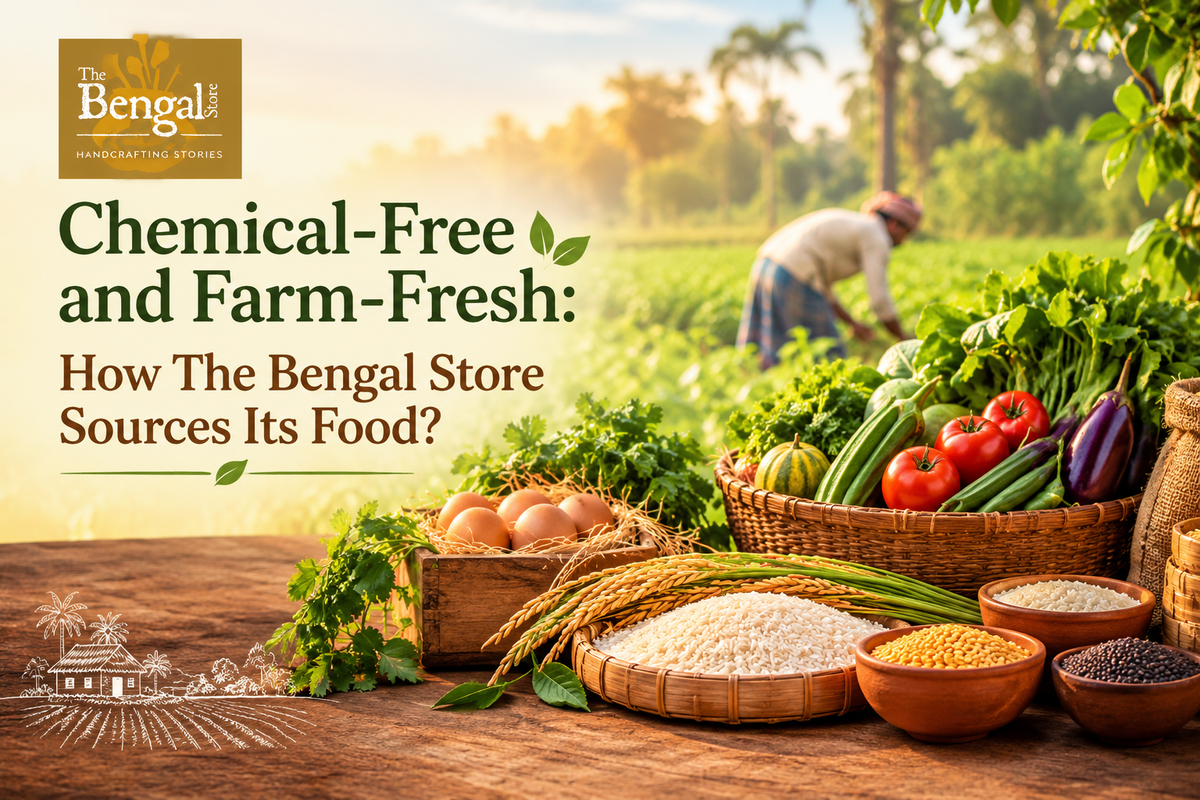
Bengal's kitchens have always run on a handful of staples grown close to home — a particular rice for payesh (Bengali rice pudding), a particular oil for cooking fish, honey that tastes different depending on which part of the delta it came from. Somewhere between the local grocer and the supermarket shelf, a lot of that specificity got lost, replaced by whatever moved fastest off a truck. Buying organic and natural food products online is, in some ways, an attempt to get that specificity back.
Quick answer: The Bengal Store sources its rice, oils, preserves and honey directly from farmers across Bengal. The store describes this range as grown or made without synthetic pesticides, chemical fertilisers or artificial preservatives. Checks such as asking about the source help when choosing natural food products online.
What ‘Chemical-Free’ Actually Means Here
The term gets used loosely enough that it's worth being precise. In this context, chemical-free means grown or made without synthetic pesticides, chemical fertilisers, or artificial preservatives — not just a marketing label stuck on packaging after the fact. It matters because these are largely staple, everyday foods: rice eaten weekly, oil used in daily cooking, pickles that sit on the table for months. Small amounts of residue add up over repeated use in a way they might not in an occasional treat.
Sourcing Directly From Bengal's Farmers
The products in this category are procured directly from farmers across Bengal, rather than through layers of distributors. This matters for two reasons. First, it's easier to know what actually went into a product when the supply chain is short — fewer intermediaries means fewer places for a chemical-free claim to quietly stop being true. Second, buying direct tends to put more of the price back in farmers' hands, which is part of what keeps small-scale, traditional cultivation viable instead of getting squeezed out by industrial-scale alternatives.
Rice is a good example of this in practice. Gobindobhog Rice (2kgs)- Chemical-free Aromatic Rice, a short-grain aromatic variety associated with Bengal's Burdwan district, is the kind of staple where sourcing quality is easy to taste — aroma and texture change noticeably depending on how it was grown.
What Counts as Organic and Natural Here
The Bengal Store's food range spans a few different categories, each sourced with the same underlying approach:
| Product | Detail from the article |
|---|---|
| Gobindobhog Rice (2kgs) | Short-grain aromatic variety associated with Bengal's Burdwan district |
| Mustard Oil | Used in everything from fish preparations to pickling |
| Pure Ghee | Sourcing quality shows up in flavour and texture |
| Pure Raw Sundarbans Honey | From the Sundarbans mangrove region, not blended from multiple sources |
| Kul Aachar (Jujube Pickle) | Made from the small, tart jujube fruit that appears seasonally in Bengal |
Products named in the article
-
Staples — aromatic rice varieties and cooking essentials grown without chemical inputs
-
Oils and fats — cold-pressed and traditionally made options for everyday cooking
-
Preserves — pickles, jams, and murabbas (fruit preserves cooked in sugar syrup) made using traditional recipes rather than industrial preservation methods
-
Forest and farm honey — raw honey sourced from specific regions rather than blended commercial honey
For cooking oil, Mustard Oil remains a kitchen essential across Bengali households, used in everything from fish preparations to pickling. Pure Ghee is another staple where sourcing quality shows up directly in flavour and texture.
Why Honey Sourcing Is Worth Explaining Separately
Honey deserves its own mention because it is sometimes diluted with sugar syrup, filtered to remove the natural pollen that shows its origin, or blended from multiple unrelated sources. Raw single origin honey is easier to trace.
The Pure Raw Sundarbans Honey available through The Bengal Store comes from the Sundarbans mangrove region specifically, rather than being blended from multiple sources. For readers curious about what makes honey from this particular region distinct, our earlier piece on the chemical composition of Sundarbans honey goes into more detail on the science behind it.
Preserves and Pickles: Where Tradition Meets Shelf Life
Pickles and preserves are where the trade-off between convenience and authenticity becomes most obvious. Many commercial pickles use preservatives and added sugar to extend shelf life. Traditional Bengali pickling methods use oil, salt, and sun-drying instead — a process that takes longer and yields a shorter shelf life, but skips the synthetic additives entirely.
A jar of Kul Aachar (Jujube Pickle), made from the small, tart jujube fruit that appears seasonally in Bengal, is a reasonable example of what that traditional approach looks like in practice — tangy, slightly sweet, and made without the shelf-stabilising chemicals found in most mass-market pickle brands.
How to Choose Genuinely Organic and Natural Food Products Online
A few things worth checking before ordering food products online, from any seller:
Steps to choose organic and natural food products online
- Check whether the listing says where the product actually comes from, not just that it is natural.
- Read the ingredient list, as shorter is usually better.
- Check the batch and shelf life, remembering that a shorter shelf life is normal for chemical-free products.
- Check the storage instructions, as products without synthetic preservatives usually need cooler, drier storage conditions.
- Treat organic labels with caution when they give no explanation of what that means for the specific product.
-
Sourcing transparency — does the listing say where the product actually comes from, or just that it's ‘natural’?
-
Ingredient list — shorter is usually better; genuine preserves rarely need more than fruit, oil, salt, and spice
-
Batch and shelf life — chemical-free products often have a shorter shelf life than mass-market alternatives, which is normal, not a red flag
-
Storage instructions — products without synthetic preservatives usually need cooler, drier storage conditions
-
Realistic claims — be cautious of ‘organic’ labels with no explanation of what that means for the specific product
Frequently Asked Questions
What does chemical-free food actually mean?
It means the product was grown or made without synthetic pesticides, chemical fertilisers, or artificial preservatives, rather than just being labelled ‘natural’ without explanation.
Where can I buy organic and natural food products online from Bengal?
The Bengal Store offers a range of organic and natural food products sourced directly from farmers across Bengal, including rice, oils, honey, ghee, and traditional pickles.
Why does honey sourcing matter so much?
Honey is one of the most commonly adulterated food products, often diluted or blended. Raw, single-origin honey is more traceable and harder to fake than blended commercial honey.
Do chemical-free pickles and preserves last as long as store-bought ones?
Usually not as long, since they skip synthetic preservatives. A shorter shelf life is typically a sign of traditional preservation methods rather than a quality issue.
Is chemical-free food more expensive?
It can be, since direct sourcing from small-scale farmers and traditional production methods generally cost more than industrial-scale alternatives. The trade-off is fewer intermediaries and clearer sourcing.
Conclusion
Sourcing food directly from farmers takes more effort than stocking at scale. For anyone looking to buy organic and natural food products online, The Bengal Store's food collection is worth a look.
Sources and further reading
- Geographical Indications Registry, Intellectual Property India: Gobindabhog Rice (GI application 531)
- UNESCO: The Sundarbans
Key terms
- Gobindobhog rice
- A short-grain aromatic rice variety associated with Bengal's Burdwan district.
- Kul Aachar
- A pickle made from the small, tart jujube fruit.
- Murabba
- A fruit preserve cooked in sugar syrup.
- Payesh
- A Bengali rice pudding.